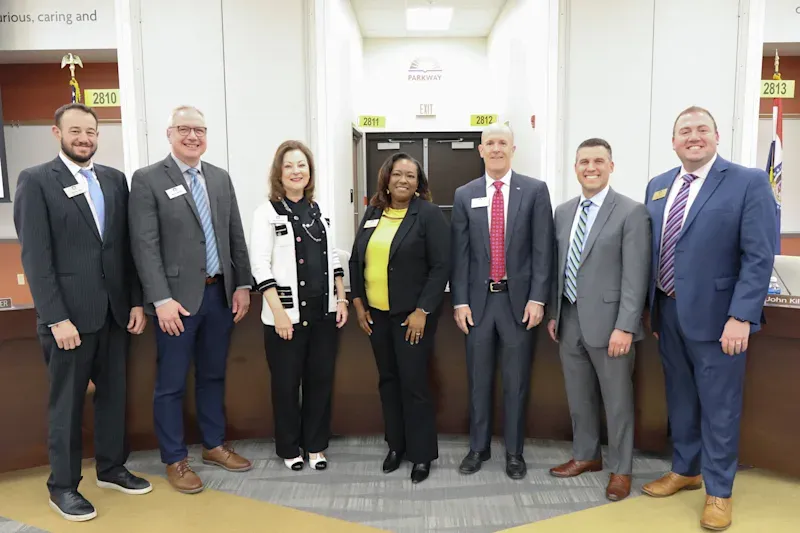
The Squeeze: How Five Forces Caught West County's Best School Districts at Once
Rockwood voters narrowly rejected a tax increase to fund teacher raises in November. Every other top-rated school district in West County is facing the same fiscal squeeze and will likely ask voters for relief in the next two years. Here is what is driving it and what it means for your tax bill.
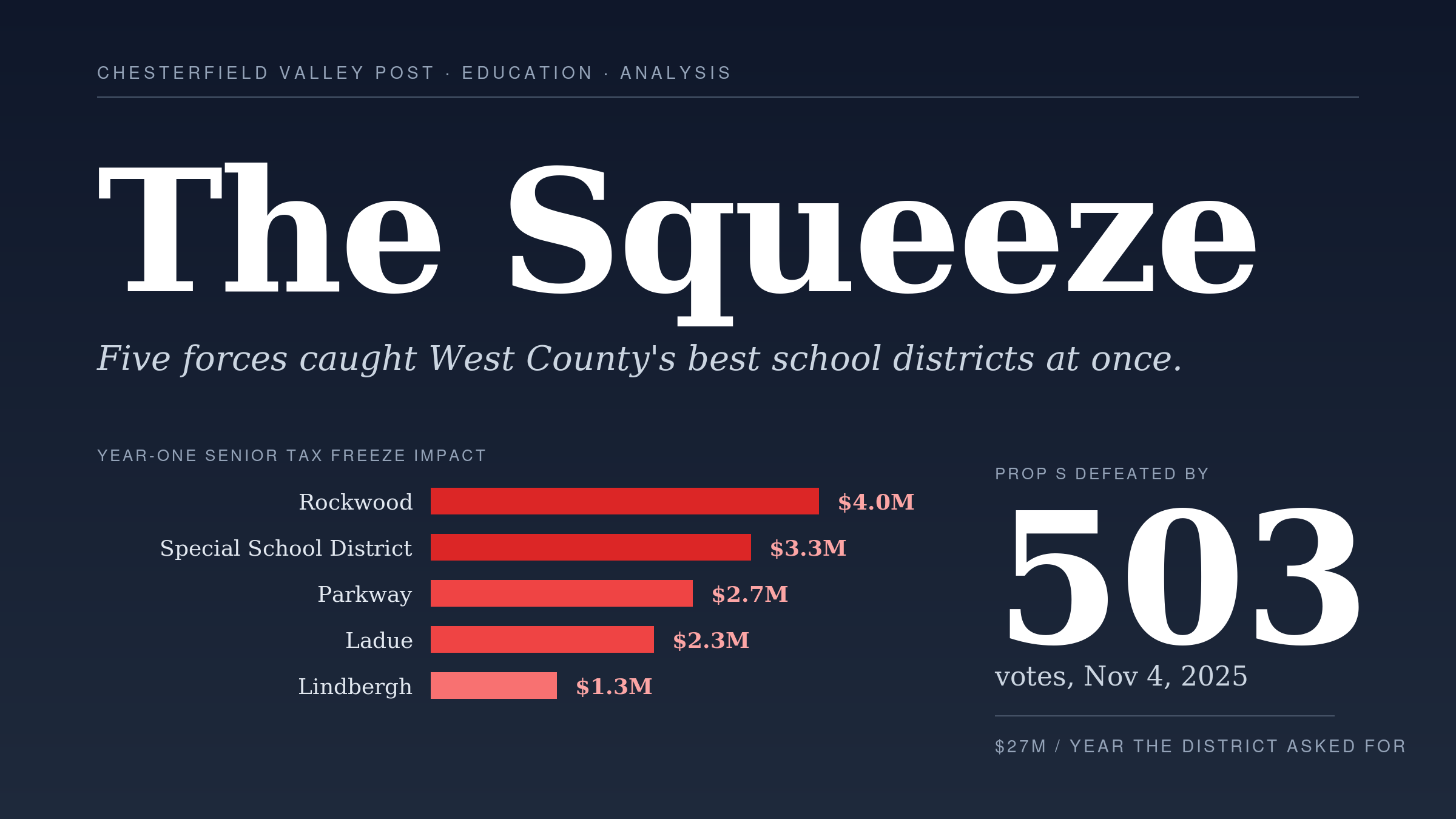
West County's "AAA" school districts spent thirty years being the model of fiscal restraint. Then five things broke at once.
The short version. Rockwood voters narrowly rejected a tax increase to fund teacher raises in November. Every other top-rated school district in West County is facing the same fiscal squeeze and will likely ask voters for relief in the next two years. Here is what is driving it and what it means for your tax bill.
On the evening of November 4, 2025, a Rockwood district resident named Blake Carlton spoke to a First Alert 4 reporter about the school district he'd just voted for. "It's a great district, great teachers, great administration all around," he said.
By the time his quote aired, Proposition S — Rockwood's first operating-levy increase (the tax rate that pays for day-to-day school costs like salaries) since 1994 — had failed by 503 votes. Carlton's reading of the loss was already the consensus on the curb: "Times are tough, money's low, so I think even more out of the pockets is the reason they voted no."
503 votes The margin by which Prop S was defeated, out of 22,323 cast.
The ask was $0.45 per $100 of assessed valuation (the taxable portion of your home's value — in Missouri, 19% of market value for a residence) — about $29 a month on a $400,000 home — to raise roughly $27 million a year. The money would have funded competitive salaries across every employee group, extended full benefits to bus drivers and classroom aides for the first time, and put two more armed safety officers in school buildings.
It failed. Narrowly. And the verdict has been read every way you can read it: as a rebuke of union politics, as anti-tax sentiment in a high-cost moment, as a referendum on a superintendent. Dennis Ganahl, chair of MO Tax Relief Now, told the St. Louis Post-Dispatch on election night that the result reflected the household reality: "It's a great moment for Rockwood families. Inflation and taxes are everybody's top problem areas. Nobody wants to be taxed [further]." All of those readings are accurate, and all of them miss the bigger story.
The bigger story is that Rockwood is not alone. Parkway, Ladue, Lindbergh, Webster Groves, Kirkwood — the entire corridor of premier West County districts that built their reputations on disciplined budgets and AAA bond ratings — entered fiscal year 2026 squeezed simultaneously from five directions. Prop S was the first ballot test of whether voters would relieve the pressure. The voters said no. The pressure is not going away.
The squeeze isn't a Rockwood story. It's a West County story.
Where the money was going
Start with the Prop S math because the numbers explain why Rockwood asked.
Missouri ranks 49th in teacher pay nationally. Last year, it ranked 50th. The statewide average teacher salary is $55,132. Within the St. Louis metro, starting teacher salaries range from $51,281 at Clayton (the top of the market) down to $44,240 at Rockwood, seventeenth out of twenty-two districts. For a master's-degree teacher, Rockwood ranks sixteenth out of twenty-two at $47,478.
17 of 22 Rockwood's rank for starting teacher pay among St. Louis metro districts.
Rockwood is also the only St. Louis County district that does not provide full benefits to bus drivers. Its administrative assistants make $15.52 an hour against Kirkwood's $21.16. Its teacher assistants make $16.16 compared to Lindbergh's $22.23. The district's "competitive salaries" argument for Prop S was not rhetorical. It was the data.
This is not a story about a struggling district trying to claw its way to mediocrity. All four Rockwood high schools — Eureka, Lafayette, Marquette, and Rockwood Summit — rank in the top 17 percent of Missouri high schools and the top 28 percent nationally, according to U.S. News & World Report's 2025-2026 Best High Schools list. The district is asking how it pays the staff who produce those results. The voters have not yet given them a sustainable answer.
Carrie Santel has been one of those staff members. A reading specialist at Ballwin and Woerther Elementaries, she spoke at a Rockwood Board of Education meeting during the 2024 contract impasse. "I really think that if they could spend the day in the life of a teacher," she told First Alert 4 afterward, "they would understand the demands we have for our job and the things that we do that are beyond just teaching each day." Thomas Cook, president of the Rockwood NEA, framed the cost of losing those staff bluntly to West News Magazine: "I know a teacher who dedicated 17 years to Rockwood, was named Teacher of the Year, and left for a higher-paying job in another district."
The case for the ballot measure was also structural. Rockwood's operating levy had not been raised since 1994. The Hancock Amendment caps annual property tax revenue growth at inflation or 5 percent, whichever is lower, which means a district that has not gone back to voters in 30 years has been compounding inflation against a fixed rate for 30 years. Seventy percent of operating revenue comes from local property taxes; only twelve percent comes from the state foundation formula. The district had been absorbing inflation with reserves and through Prop 3 in 2023 — a no-tax-increase levy transfer that created a dedicated capital fund. Prop S was the salary side of the same machine.
The vote was 11,413 to 10,910. Superintendent Curtis Cain, asked after the defeat whether tense salary negotiations with the Rockwood NEA had hurt the result, gave the only honest answer: "I think it would be completely disingenuous to sit in this room to look you in the face and say, no, I don't think it had any impact."
The district ratified a 6.27 percent raise anyway, through the RNEA contract approved in March. Starting teacher pay moves to $47,014 for 2025-26. That still keeps Rockwood near the bottom of the metro. The raise was structured to "borrow" from year three, which means a salary freeze is now mathematically on the table for 2027-28 unless something else gives.
Rockwood is paying below the market that produced its results.
The senior tax freeze: $30 million out the door
Then there is the first new pressure, and it is the biggest.
In 2023, Missouri passed SB 190, which allowed counties to freeze property tax bills for senior homeowners on their primary residence. The 2024 expansion, SB 756, added teachers, firefighters, and railroad employees. St. Louis County implemented the program for tax year 2024, with the first full revenue impact landing in fiscal year 2025.
The county received more than 82,000 applications in year one and approved roughly 70,000 of them. Seniors saved approximately $30 million in property taxes. That $30 million did not vanish from the economy; it stayed with homeowners and stopped flowing to the taxing entities that depended on it. Schools absorbed the largest share.
Rockwood took the biggest single-district hit: approximately $4 million. "Four million dollars is not a small amount of money,the and it's nothing to sneeze at," Cain said.
$4 million What the senior tax freeze cost Rockwood schools in its first year. The hit compounds annually. Parkway lost $2.7 million across its operating and debt service funds. Ladue: $2.3 million. Lindbergh: $1.3 million. The Special School District, which serves students across the county, lost $3.3 million and responded by freezing staff salaries for 2026-27.
Webster Groves lost $495,000. On a smaller budget, that is consequential. The district, per the more seniors enroll annually, the gap between what the district would have collected and what it actually collects widensWebster Kirkwood Times reporting, is now projecting a $5 million deficit for fiscal year 2026-27. The senior freeze accounts for about ten percent of it.
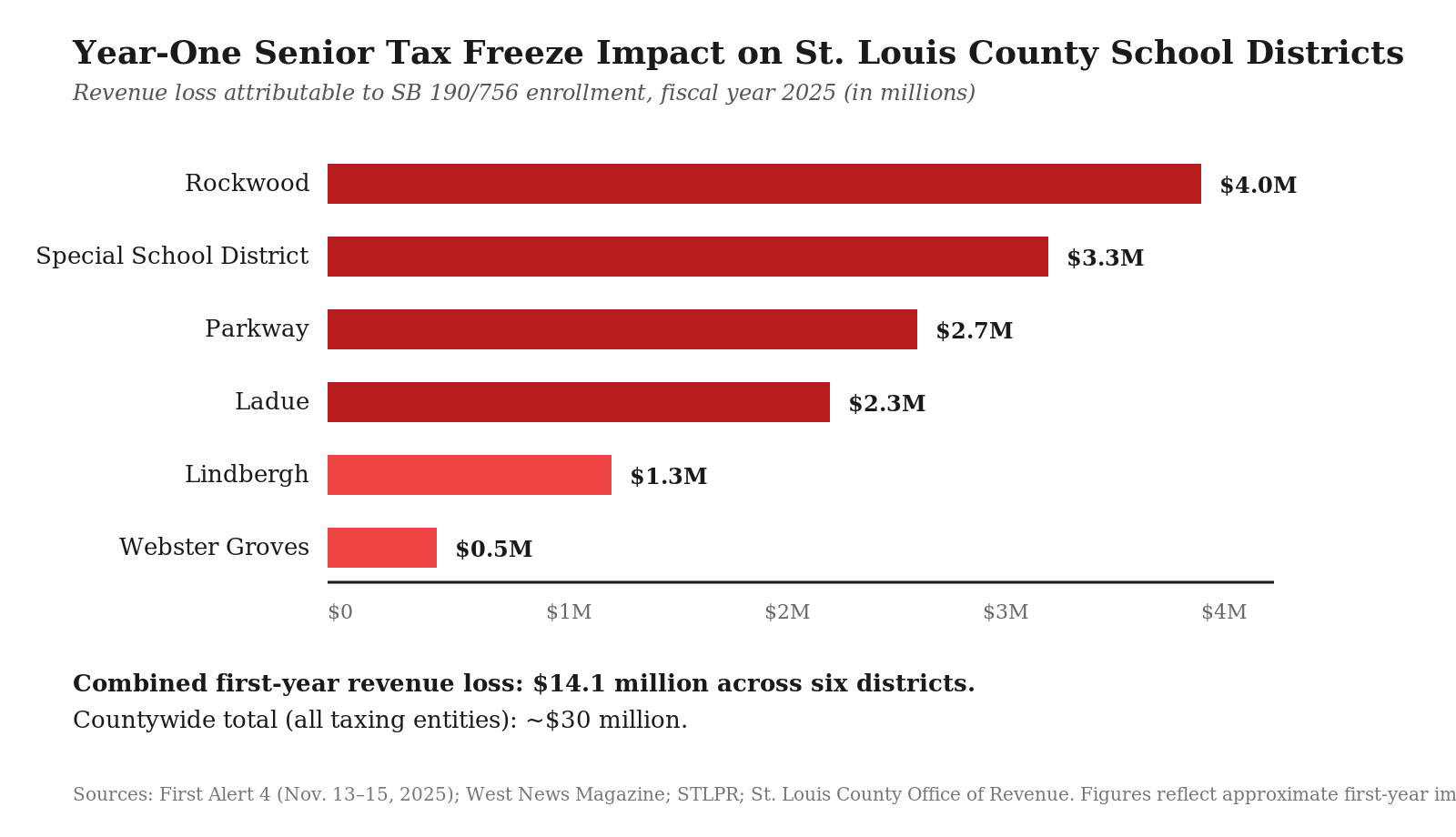
The math problem with the freeze is not the first-year hit. It is the compounding. Parkway Chief Financial Officer Carrie Nunn projects a $26 million revenue loss to the district over ten years, because the freeze locks each enrolled senior's bill in place permanently. As assessments rise and more seniors enroll annually, the gap between what the district would have collected and what it actually collects widens.
A coalition of Missouri school districts, fire districts, and local governments has filed suit in Cole County Circuit Court arguing SB 190/756 violates Article X of the Missouri Constitution. A January 2026 ruling allowed April ballot measures to proceed, but the trial is pending. St. Charles County voters rejected a sweeping freeze in April 2026. The legal and political question remains live; the cash impact has already landed.
The freeze took $14 million out of six West County districts in one year. It compounds every year after.
Healthcare: the silent ten-million-dollar problem
The second pressure is healthcare inflation, and Parkway is the public case study.
In 2024, Parkway's healthcare costs rose by fourteen percent — an additional $5.3 million in one year. The district is now drawing $7.5 million from operating funds to strengthen its self-funded insurance reserve (a plan in which the district pays employees' medical bills directly rather than purchasing insurance from a carrier). Employees absorb the rest through higher premiums and deductibles.
$5.3 million Parkway's healthcare cost increase in 2024 alone. It is the single fastest-growing line in the district's budget.
To cover the gap, Parkway cut roughly $12.7 million from its budget for the current year: a ten percent reduction in supplies and purchased services, unfilled vacant positions used as a budgeting lever, professional development scaled back, and even food at district meetings was eliminated. Salaries, step increases, and stipends were explicitly protected.
Superintendent Keith Marty's framing was deliberate: "We must protect our community's investment and trust while also responding to external circumstances and rising costs that are outside of our control." Healthcare inflation is exactly the kind of externality the line refers to. Every premier West County district is absorbing some version of this. Parkway is the one being most transparent about the numbers.
The Parkway case also illustrates a quiet truth about the AAA districts. Their fund balances look enormous on paper — Parkway's total governmental fund balance was $264 million on June 30, 2025; Rockwood's projected ending balance is $128.7 million. Both look like rainy-day arsenals. They are not. A significant share of each is committed to debt service, building and capital, and self-sustaining funds. Parkway is now drawing $7.5 million from its operating fund to keep its insurance plan solvent. That is the reserve doing its job. It is also the reserve that is not available for anything else.
Even the best-funded districts cannot absorb 14% annual healthcare inflation indefinitely.
State funding: the quiet bleed
The third pressure is the state.
The Missouri foundation formula (the state's basic math for how much it sends each district per student) was appropriated at $4.3 billion for fiscal year 2026. Flat. The first year since 2017 has seen no increase. The Department of Elementary and Secondary Education had requested hundreds of millions more to fully fund the formula under the SB 727 changes the legislature passed in 2024 — changes that shifted from attendance-based to enrollment-based counts and raised the state adequacy target from $6,375 per pupil to $7,145. The legislature did not appropriate the increase. The formula is now structurally underfunded by roughly $138 million in projected lottery, gaming, and cigarette receipts.
What does that look like at the district level? Ritenour Superintendent Chris Kilbride told STLPR the money his district will not receive this year would have been enough to cover all of his bus drivers' salaries and benefits, or the cost of running the district's libraries and media centers, for a year. "We're heading into a time of a high level of uncertainty around funding," Kilbride said, "and that's the worst thing I would say for children." St. Louis Public Schools budgeted a $33.4 million deficit for fiscal year 2026.
West County districts feel this differently than St. Louis Public Schools or Ritenour, because they are less state-dependent. Rockwood receives 12% of its operating revenue from the state. Parkway gets less than five percent. But the formula is the rising tide for everyone, and the tide is not rising. SB 727 promised more per-pupil funding. The appropriation did not arrive.
Districts cannot expect Jefferson City to backfill the losses they incur locally.
The ESSER cliff and the income-tax wildcard
The fourth pressure is the federal cliff. Missouri received $1.9 billion in ESSER funds — the federal COVID relief money for schools, roughly $3,000 per student — to absorb pandemic learning loss. The obligation deadline was September 2024; the spending cliff hit January 2025, with extensions running into March 2026. National analyses suggest average districts must absorb $1,200 per student in post-ESSER cuts. West County districts spent ESSER money on staffing, technology, and tutoring. Some of those positions were absorbed into base budgets. Many were not. The cliff is real, and it is now.
The fifth pressure is the one with the longest tail: Missouri's income tax.
Governor Mike Kehoe is pushing to eliminate the state's individual income tax, which generates roughly $8.5 to 9 billion a year — sixty to sixty-five percent of general revenue and the largest single funding source for public schools. The Senate version of repeal carries a $4.2 billion first-year cost. Voters will decide Amendment 5 in 2026, which would eliminate the income tax and replace it with higher sales taxes. Public policy analysts have compared it to Kansas's 2012 income tax experiment, which forced two-day school weeks in some districts before the legislature reversed the policy five years later.
Whether Amendment 5 passes or not, the conversation alone is shaping district planning. Rockwood's Prop S vote came two months before Amendment 5 reached the ballot. Voters making decisions about local property taxes are doing so with full knowledge that state aid could be compressed further. That is the pincer.
COVID money is gone. State income tax money may be next. Local property taxes are now carrying the load alone.
The peer picture
Lined up side by side, the West County districts look like this for 2025-26:
| District | Enrollment | Operating Budget | Tax Rate | Bond Rating | Senior Freeze Hit |
|---|---|---|---|---|---|
| Rockwood | 18,566 | $281.2M | $3.8816 | AAA | $4.0M |
| Parkway | 16,434 | $277.3M | $3.8673 | AAA | $2.7M |
| Lindbergh | 7,497 | $84M | $3.7636 | AAA | $1.3M |
| Kirkwood | 6,096 | n/a | Lowest in 30+ yrs | — | n/a |
| Ladue | 4,492 | $87.9M | n/a | AAA | $2.3M |
| Webster Groves | 4,407 | n/a | n/a | — | $0.5M |
What this table does not show — and what the AAA rating obscures — is that every one of these districts is now drawing on operating reserves to absorb the same five pressures. Parkway is the one being open about it. Rockwood was the one asking voters for relief. Webster Groves is the one staring at a $5 million deficit. The rest are running the same math privately and arriving at the same answer: structural deficit through the late 2020s, paid out of reserves until something gives.
What does it cost you
Missouri assesses residential property at nineteen percent of market value. The school portion of the tax bill on a $500,000 West County home, before any senior freeze or other credits, works out to:
| District | 2025 Levy (per $100) | Annual School Tax on $500K Home |
|---|---|---|
| Rockwood | $3.8816 | $3,687.52 |
| Parkway | $3.8673 | $3,673.94 |
| Lindbergh | $3.7636 | $3,575.42 |
| Mehlville | $3.7016 | $3,516.52 |
Had Prop S passed, the school portion of a $500,000 Rockwood homeowner's bill would have risen by $427.50 a year — about $36 a month — to roughly $4,115. The owner of a $400,000 home would have paid an extra $342 a year, the figure the district cited as "less than $29 a month." Missouri assesses commercial property at 32 percent of market value, not 19 percent, so the bill on a commercial parcel of similar market value runs roughly 68 percent higher. These are school taxes only.
What this means for you. If your home is worth around $500,000 in the Rockwood district, your school tax bill is roughly $3,688 a year today. If a future levy passes at the same rate Prop S proposed, that bill rises to about $4,115 a year — about $36 a month more. If no future levy passes, expect class sizes to grow, programs to thin, and the next ballot question to come within two years anyway. The pressure does not disappear because the vote fails.
What the Prop S vote actually means
The lazy reading of Prop S is that West County taxpayers are exhausted. There is truth in that — assessments are rising, food is expensive, the senior freeze itself is a signal that voters wanted relief. But "tax fatigue" as a frame mostly tells you what voters did, not why the districts asked.
The districts asked because the local property tax model that built West County's premier school system is no longer keeping pace with the system's actual costs. Salaries are below market. Healthcare is increasing by 14% per year. The state will not backfill. The federal cliff is here. Seniors are exiting the property tax base. And the largest single source of state funding for schools may be on the ballot for elimination.
A 503-vote defeat in November did not resolve any of that. It deferred it. Rockwood will be back, probably within two years, with a smaller ask or a different structure. Webster Groves will face its own ballot question. Parkway, which has not asked voters for an operating increase in years, will run the same math by 2027. Every district in the corridor is doing the same fiscal arithmetic, with the same five variables, against the same calendar.
The AAA rating reflects the past. It shows these districts managed their fund balances responsibly during a long stretch of rising assessments, growing enrollments, and federal stimulus. It does not tell you whether they can absorb what is coming. They are about to find out together.
The vote did not resolve the squeeze. It deferred it. Every district in the corridor is doing the same math against the same calendar.
What to watch
Three things will tell you how this ends.
The legal challenge to SB 190 and 756, which could limit or reverse the senior tax freeze before it compounds. A ruling against the state would return roughly $30 million a year to St. Louis County taxing entities. A ruling for the state writes the current arithmetic into permanent law.
Amendment 5 on the 2026 ballot. Eliminating income tax would force a generational restructuring of how Missouri funds schools. Whether it passes or fails, the conversation will affect every district's 2027 budget planning.
And the next ballot asks. Rockwood will not be the last. Webster Groves, staring at a $5 million deficit, is the obvious next candidate. Parkway, which has not asked voters for an operating increase in years, will run the same math by 2027. The question is which district goes next, what they ask for, and whether voters who said no to Rockwood say yes to a different package. The structural pressure is not patient. The math is not patient. West County is about to learn how patient it is.